Our country has embarked comprehensive reform programs for business registration with the promulgation and implementation of the Enterprise Law 1999. Over time, the legal framework for business registration has been improved to best meet the requirements of reality, ensuring the meaning and role of business registration in the economy in general and creating the driving force for business development in particular. With the close guidance of the Government and the efforts of the relevant ministries and agencies including the Ministry of Planning and Investment as the lead agency, the positive results of business registration reform have been appreciated by international community and businesses. The Provincial Competitiveness Index (PCI) survey during 2006-2016 has consistently noted the most noticeable improvements in the Market Access category, which has been leading the PCI rankings for 11 consecutive years.
I. The context of business registration reform
Since 2007, the business registration reform program has been initiated with the issuance of the Resolution No.59/2007/NQ-CP dated 30/11/2007 by the Government and the joint circulars of the three ministries including Ministry of Planning And Investment, Finance and Public Security. These normative documents have paved the way for the one-stop-shop mechanism between the procedures of business registration, tax registration and seal making. At the same time, the process of business registration and tax registration has been merged into a single business registration procedure. Thereby, establishing the legal principle that business registration information stored in National Enterprise Registration Database are considered original and legal information about the enterprise, creating a legal basis for online business registration and information provision for the community. On December 31, 2010, the National Business Registration System was officially put into operation nationwide, contributing to making business registration and tax registration integration become the first electronic interconnection model used among state agencies.
Next, the Enterprise Law 2014 and guiding documents such as Decree No.78/2015/ND-CP, Circular No.20/2015/TT-BKHTT guiding enterprise registration, Circular No.01/2016/TTLT-BKHDT-BTC on the provision of enterprise information between the tax office and the business registration office, Circular No.04/2015/TTLT-BKHDT-BTC-BNV on the promulgation of the model regulation on coordination among functional agencies in provinces and centrally run cities in the state management of enterprises after establishment registration, Circular No.05/2016/TTLT-BKHCN-BKHTT on guiding measures against corporate names that infringe industrial property rights, and Circular No.02/2017/TT-BKHDT on guiding the mechanism for cooperation between investment registration and business registrationhave contributed to improve the legal framework for business registration in order to facilitate this work to promote its role in business development.
II. Some outstanding contribution of business registration to the development of business
1. Business registration reform helps enterprises be “born”, changing their organizational structure and making withdraw from the market more conveniently and less costly
Any individual or organization wishing to enter the market must carry out registration procedures for incorporation in accordance with law to determine the legal status of the business. This is the first administrative procedure that a business must undertake before commencing its business, marking the birth of a company that is legally recognized as an entity engaged in the economy with full rights and obligations. With its legal nature, business registration is to protect the interests of enterprises, laying the foundation for enterprises to turn into economic entities that are eligible to enter the market.
Recognizing the importance of the above-mentioned procedure of business registration for enterprises, throughout the reform of business registration, it is aimed at maximizing the advantage for enterprises, helping enterprises to enter the market with the shortest time and the cheapest cost. Accordingly, since 2007 when business registration procedures are carried out in connection with tax registration procedures and seal-related procedures, the procedures for business registration have gradually been simplified, saving time and costs significantly for enterprises when they join and operate in the market. Specifically, the time taken to complete the basic procedures of business registration has been reduced from 32 working days (prior to 2005) to 22 working days (since the Enterprise Law was enacted), to 15 working days (since 2007), to 5 working days (from 2008 to 2014) and to only 3 working days as nowadays.

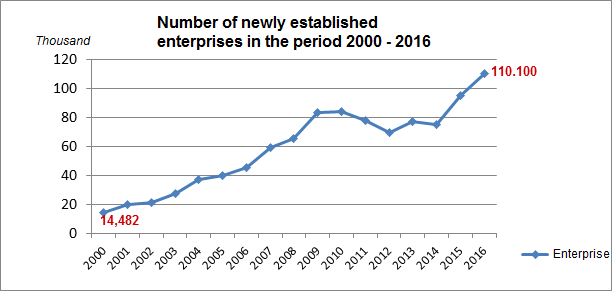
The actual processing time is even less than the prescribed time. Specifically, according to statistics from the National Business Registration System, the average processing time of registration dossiers for the establishment of new enterprises in the whole country is now only 2.9 days; the average processing time of registration dossiers for changing enterprise registration information is 2.05 days, which is faster than the time regulated in the Enterprise Law 2014. The rate of first-time approval is 86%, while the percentage of timely result returns is 90%. With vigorous reforms in the legal framework, as well as the improvement of information technology infrastructure and the change in management thinking of business registration officers, the number of newly established enterprises is constantly on the rise. Especially in 2016, it witnessed an unprecedented record high of 110,100 enterprises, which reflected an increase of 16.2% over 2015. The committed capital was 891,094 billion, which was equivalent to VND8.09 billion for each newly established enterprise, reflected a significant rise of 48.1% over the same period in 2015.
The National Business Registration Portal also provides support tools for enterprises and business start-ups in the process of submitting applications directly at the Business Registration Office. In the case of direct submission, enterprises and business founders can also look up the status of processing dossiers on the Portal, or check the reasons for requesting amendments and supplements to the dossiers (if any) without going directly to the Business Registration Office, which help saving time and money for people and businesses.
In addition, the Enterprise Law 2014 and its guiding documents also stipulate simpler registration dossiers for enterprises, removing pre-registration papers such as certificates. Information on business lines no longer has to be inscribed on the business registration certificate, thus creating conditions for enterprises to have the right to freely conduct business in the business lines not prohibited by law. Thanks to that, enterprises just need to list out planned business lines on request paper and only notify business registry when that information is changed. For the seal, the provisions of the Enterprise Law and its guiding documents are also implemented in the direction of gradually reducing dependence on the seal. For example, in the business registration dossier, there are papers which are not required to be stamped.
Regulations on corporate dissolution are also simpler and clearer, facilitating businesses to withdraw from the market and to prepare for new business opportunities.
2. Business registration reform is a basis for better coordination between State management agencies to better support enterprises
It can be said that the coordination between the business registration agencies and other State management agencies such as taxation, police and intellectual property has facilitated the management of enterprises as well as has directly supported enterprises in the process of joining, developing their business and withdrawing from the market as well. For example, from 2010 up to now, the business registration agencies and the tax offices have connected and exchanged information through the National Business Registration System and the Tax Registration System. Along with that, there has been the coordination of review and synchronization of enterprise registration information, which has contributed to improving the State management of business registration and ensuring the timely delivery of all necessary legal information on business registration for relevant agencies, the business community and individual organizations in need. This has been worthy in increasing the transparency of the business environment. For public security agencies, in the case of verification of business registration documents is falsified as the basis for the revocation of enterprise registration certificates, the normative documents also clearly state that public agencies are responsible for identifying the fraudulent factors in dossiers and making a reply within 30 days... For intellectual property infringement issues, the business registrars and the department of intellectual property have also made a coordinated mechanism to handle enterprises infringing upon intellectual property rights, creating conditions for enterprises to protect their legal rights. Besides, the regulations on antimicrobial names of enterprises have also made it easier for enterprises to protect their business names.
3. Business registration reform helps enterprises develop in a transparent and open business environment
It can be said that information has always been considered as an effective tool to support enterprises in their process of operation, finding partners as well as the basis for enhancing the social supervision of enterprises’ operation. Since 2010, implementing the plan in the reform program of national business registration, on the basis of the merger of discrete data from 65 business registration offices across the country and compare with the database in the taxation system, the National Business Registration Database has kept legally binding information of nearly 1,000,000 enterprises and 300,000 dependent units on a country scale.
Based on the information of legal validity extracted from the National Business Registration Database, the National Business Registration Portal has provided search engines, allowing users to search for basic, free and valid information of the enterprise, including name of the enterprise, abbreviated name of the enterprise name of the enterprise written in foreign language, enterprise code, enterprise type, status of enterprise, its legal representative, address of the head office, list of business lines, form of the seal and list of published announcements of the enterprise. Thus, all organizations and individuals are able to access more quickly and easily with legal information about enterprises through a single and valid legal information point, which replaces the traditional tool known as the “ask-and-give” mechanism. The information products and services create favorable conditions for business cooperation and business activities, help individuals and enterprises to approach and manage customers better, expand the market, seek direction and trend of the market economy, through that reducing risks in commercial and civil transactions, and enhancing the social supervision of the whole community as well as transparency of the business environment in Vietnam.
In addition, in order to create more favorable conditions for enterprises to enter the market, at the same time, to develop a modern public administration service, based on the success of the National Business Registration System, the Ministry of Planning and Investment continues to develop the enterprise registration component via the Internet on the National Business Registration System. Online business registration procedure meeting the requirement for a 4-level public online service reduces the time and cost of entering the market for businesses, contributes to a smooth, transparent administration through minimizing negative issues can arise from human intervention.
Up to now, there has been 15.6 thousand online business registration dossiers submitted successfully in the whole country. The rate of online application compared to the documents submitted has gradually increased each year. According to the National Business Registration System, in 2016, the online business registration rate was 14%, and in the fourth quarter of 2016 it was 35.26%.
4. Business registration reform helps enterprises access and utilize modern public services
On April 15, 2013, the National Business Portal for Enterprise Registration has officially come into operation as an electronic portal used by organizations and individuals to register enterprises. Through the Internet, access, look up information about businesses as well as to use online public services. Over the past few years, along with several upgrades to comply with the new Enterprise Law, Investment Law and guiding documents, the National Business Information Portal has become an familiar place for users to try online public services such as online business registration; enterprise registration information service; electronic declaration of business registration information; standardization of business registration data, etc.
According to data taken from the Agency for Business Registration, as of 23/5/2017, the total number of access to the Portal reached 114,665,336. The specific number of hits per page is summarized in the table below:

It can be seen that the National Business Registration Portal is becoming a familiar address for people and businesses to exploit and use online utilities and services as well as search for information of the business, thereby reducing the costs and risks for the business.
Over the past 20 years, the business registration has made many important changes, better meeting the needs of the economy, especially for the economic growth of private entity. The improvement in market entry procedures has created a great attraction for the business environment of Vietnam in the eyes of investors. In the coming time, the reform of business registration should continue to be strengthened in order to step by step bring the business registration management process of Vietnam closer to international standards. Through that, we could create a business environment that is advanced, effective and transparent for the business community, domestic and international investors when entering the Vietnamese market.
Tran Thi Hong Minh
Agency for Business Registration